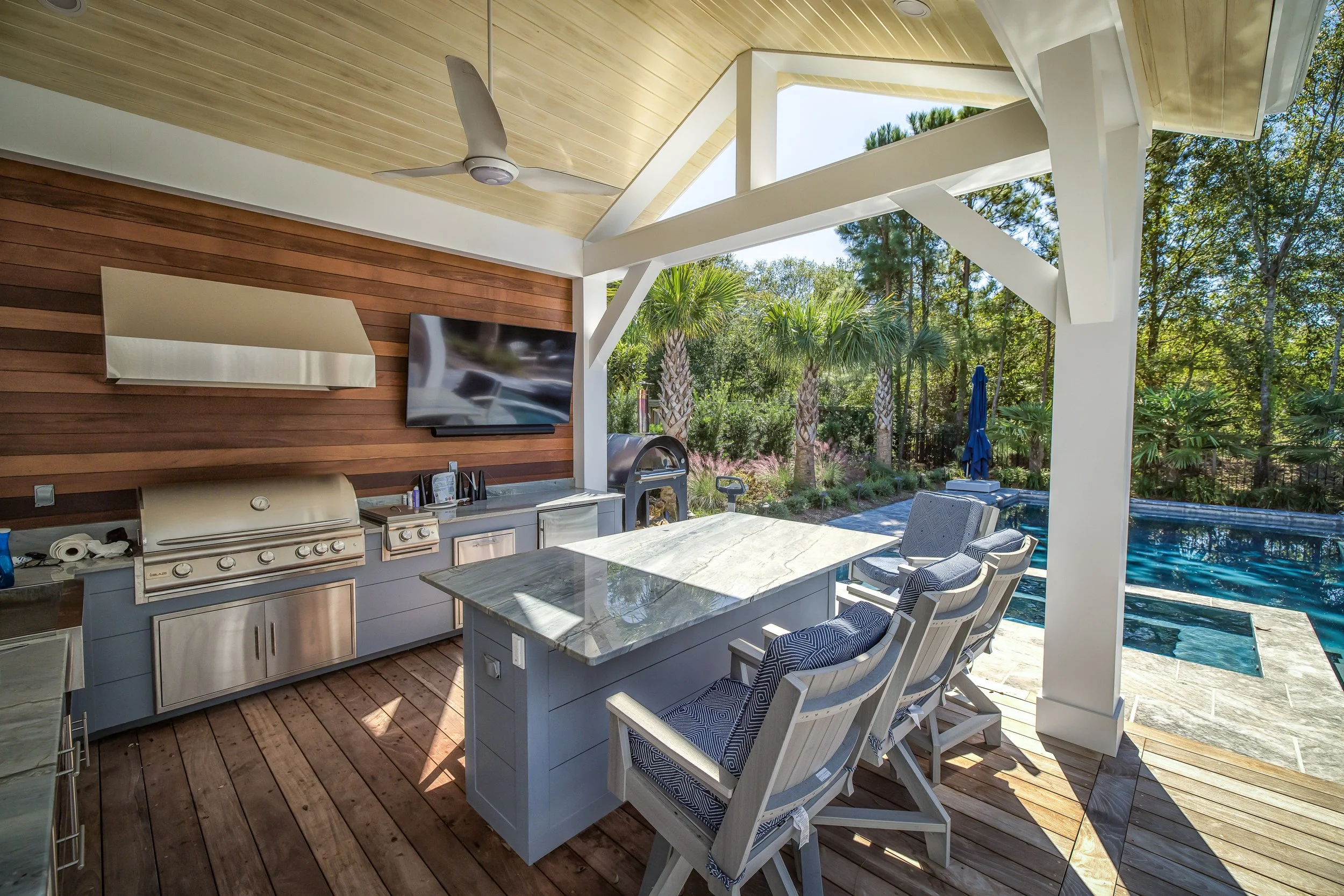
A custom outdoor kitchen in Wilmington, NC faces a corrosive atmosphere every day of its life, and the specification decisions that resist it are invisible on a rendering and obvious after four years. Salt is patient.
Since 2013, Element Outdoor Living has grown to a team of more than 50 across the Greater Wilmington area. We design and build with materials that stand up to salt air, humidity and the coastal climate, and this article covers which ones those are.
Related: How an Outdoor Kitchen Becomes the Most Used Space on the Property in Wilmington, NC
Which Stainless Steel Belongs in a Coastal Outdoor Kitchen?
Marine-grade stainless belongs in a coastal outdoor kitchen, because not all stainless resists chloride equally. The grade commonly used for indoor appliances pits and tea-stains in a marine atmosphere, while marine grade holds a cleaner surface considerably longer in the same conditions.
The distinction applies to the fasteners as much as to the doors and drawers. A marine-grade cabinet hung on ordinary screws fails at the screws, and the same goes for hinges, handles and the brackets carrying a countertop.
On our kitchens, appliance housings, fasteners and hardware are specified in marine-grade stainless where exposure warrants it.
What Should an Outdoor Kitchen Carcass Be Built From?
An outdoor kitchen carcass should be built from masonry or a non-combustible frame with a cement board skin, which is the structure most coastal kitchens rely on. The finish goes over that structure rather than carrying the load.
Wood-framed boxes are where humidity does its quietest damage. The box sits enclosed and does not dry, and the failure appears as a sagging door long before anyone looks at what is behind the stone.
Related: Salt Air & S’mores: Outdoor Fireplace & Outdoor Kitchen Ideas for Wrightsville Beach, NC, Homes
Which Countertop Materials Handle Humidity and Sun?
Dense, low-absorption stone handles humidity and sun better outdoors than a porous one, though darker surfaces gain a great deal of heat in direct coastal sun. Those two considerations sometimes pull in opposite directions, which makes countertop choice a design conversation rather than a default.
Sealing is maintenance rather than a one-off. A surface resealed on a sensible cycle keeps its appearance, and one that is not shows every spill from the second summer onward.
Agreeing that cycle during design means the homeowner knows what the material asks of them before they choose it.
How Do Cover and Orientation Change an Outdoor Kitchen Build?
Cover and orientation change how much salt, sun and rain every component takes. A covered kitchen sees less of all three, and that reduction shows in how long each part lasts, though it also introduces ventilation requirements that an open counter does not have.
Orientation matters alongside it. A counter facing prevailing wind off the water takes more salt deposition than the same counter turned ninety degrees, and that is settled at the design stage for free.
What Utilities Does an Outdoor Kitchen Need Coordinated Before Construction?
Gas, electrical, water and drainage all have to reach an outdoor kitchen, and the runs are easier before the hardscape goes down than after. Retrofitting a line under finished paving is the expensive version of the same job.
Appliance placement drives those runs, so the appliances are selected during design rather than chosen afterward.
A refrigerator and an ice maker also want a circuit that reflects where they actually sit outdoors, and a grill wants gas sized to its output rather than to the nearest convenient tap.
Specify Your Custom Outdoor Kitchen in Wilmington for the Coast
The material decisions above take one design conversation, and they govern how this kitchen looks a decade from now.
Element Outdoor Living designs and builds outdoor kitchens and outdoor living environments throughout the Greater Wilmington area.
Book your outdoor kitchen design consultation with Element Outdoor Living.
In Summary
How much maintenance does a coastal outdoor kitchen need?
A coastal outdoor kitchen needs regular rinsing of salt deposition off stainless surfaces and resealing of stone on its cycle. Element Outdoor Living specifies marine-grade stainless hardware where exposure warrants it, and the rinse frequency follows how exposed the kitchen is rather than a single schedule.
Can an outdoor kitchen be added to an existing patio?
An outdoor kitchen can often be added to an existing patio, provided the paving can carry the structure and the utilities can reach it. Both questions are assessed before design rather than discovered during installation.
Do appliances have to be chosen before construction starts?
Appliances need to be chosen before construction starts, because the cabinet openings, the gas sizing and the electrical runs are all built to the units selected. Changing an appliance afterward usually means altering the carcass.
Related: Outdoor Living & Outdoor Kitchen in Kure Beach, NC: Choosing Features That Fit Your Lifestyle